 Göreme City Guide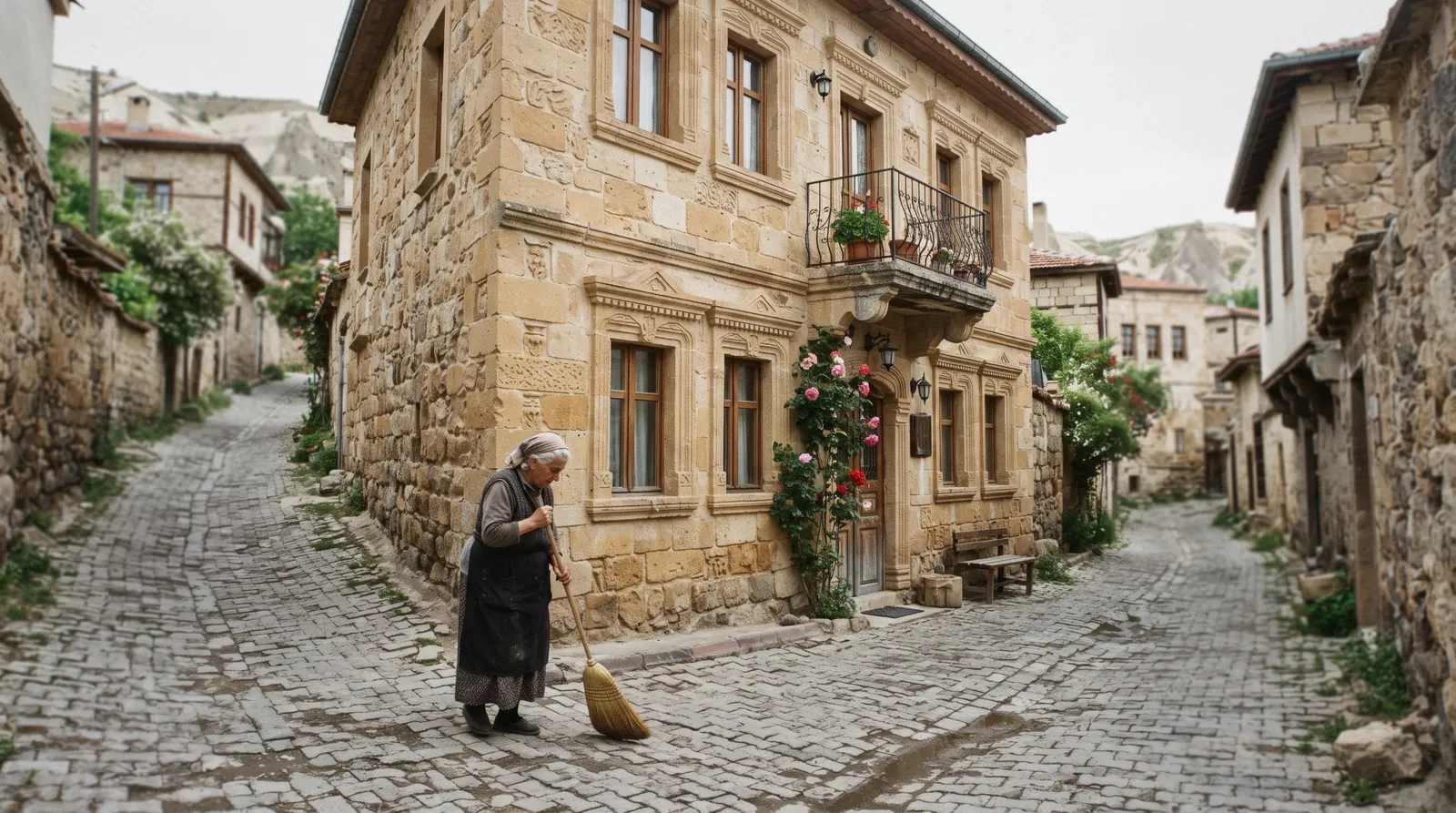
Mustafapaşa (Sinasos)
Mustafapaşa, the village the Greeks called Sinasos, sits 6 km south of Ürgüp and is the quietest of Cappadocia's six tourism villages. A population of 1,295 lives among stone mansions built with money earned in the caviar trade, and among carved churches in the valleys around the houses, and a university annex keeps the cafés open after the day buses leave. The village has no entrance ticket and nothing that needs booking, which makes it the easiest half day in the region to improvise. This page covers the history, a walk through the village in working order, Gomeda valley, and how to reach it from Ortahisar, Ürgüp or Göreme.
Quick answer What Sinasos was, what there is to see, is the trip worth it
Mustafapaşa is the village the Greek Orthodox merchant community of Sinasos built, stone mansions, a carved 1729 basilica and rock-cut churches in the valleys around it. It is worth half a day for anyone who has seen the headliners, and it is the quietest of the region's six tourism villages.
Key takeaways
- The village has no entrance ticket and nothing is bookable, access to the churches varies by day. The village walk.
- Reach it through Ürgüp, 6 km south, by dolmuş, taxi or car. Getting there, with the Ürgüp terminal timetable.
- No big-bus tour stops here. The format that reaches Sinasos is a private day with car and guide.
Sinasos among the villages
The three southern villages work as half-day trips from the Göreme basin. The populations below are the 2022 address-based census counts, and the distances are by road.
| Village | What it was | The sight now | People (2022) | From Ürgüp |
|---|---|---|---|---|
| Mustafapaşa | Sinasos, a rich Greek merchant town | Mansions, the Constantine and Helena church, valley churches | 1,295 | 6 km south |
| Ortahisar | A farming town under a fortress | A 90-m rock castle with working fruit stores | 3,086 | 6 km west |
| Ürgüp | The district capital and wine market | Wine cellars, Temenni Hill, the Three Graces | 24,647 (district) | You are there |
The counts are the 2022 address-based census figures, and the third column matters because of them: a village of 1,295 absorbs tour groups differently from a town of 25,000. For the fortress town see Ortahisar, for wine and evenings the district capital in the Ürgüp guide.
From Sinasos to Mustafapaşa
One name hides the other, and the money story explains every facade you will photograph.
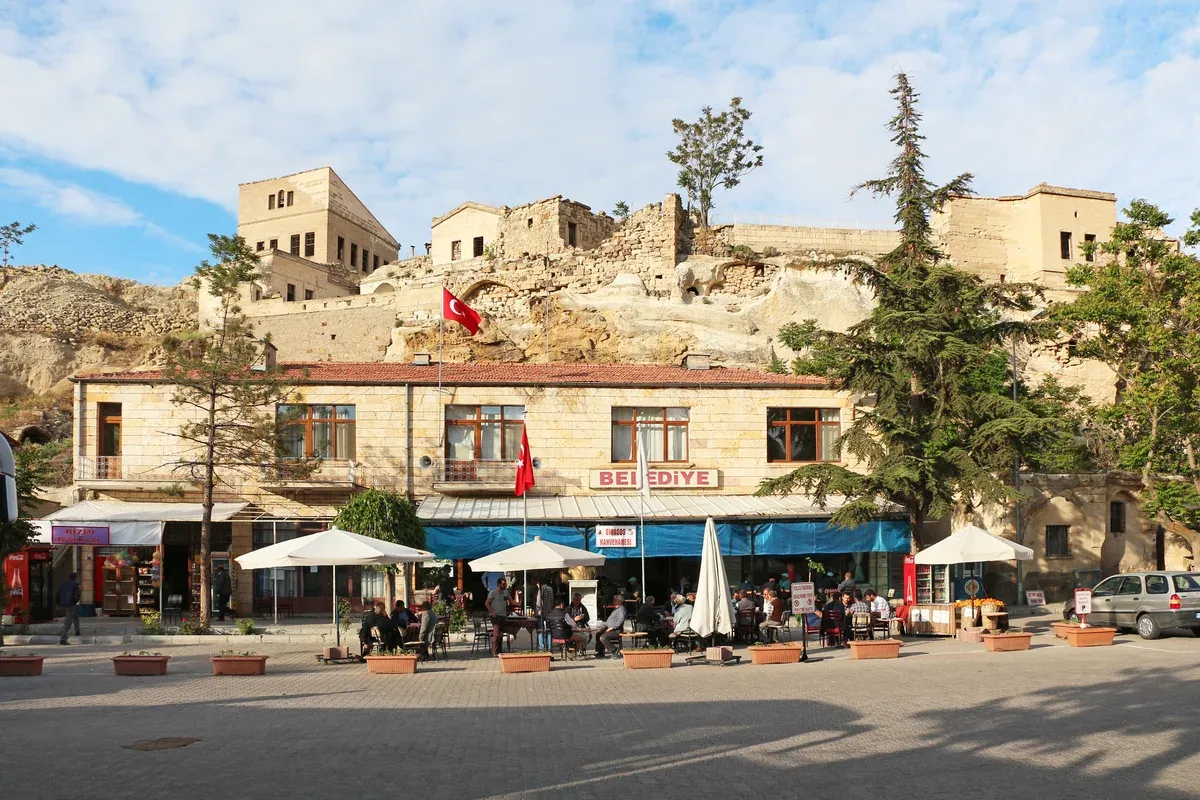
Photo: Bernard Gagnon, CC BY-SA 3.0, via Wikimedia Commons
The caviar merchants and their houses
In the 19th century Mustafapaşa was Sinasos, a predominantly Cappadocian Greek town, some of whose people were Turkish-speaking Greeks. Central Anatolia was a hard place to earn, so Sinasos men migrated to Constantinople and made their names trading seafood, caviar above all, and sent money home. That money built the grand stone mansions that survive today, and the village counted about 3,000 Greeks and 1,000 Turks in 1905.
The same community ran a second economy at home, wine production on the vineyard slopes and a known trade in medicinal herbs, so the village was a commercial operation on two fronts rather than a farming settlement with nice houses. The township registry counts some 200 protected historic buildings, and local promoters put the mansion stock at its peak near 700. The name legends say the village took its Turkish name from a Mustafa Pasha who drilled the village a well, or from Mustafa Kemal Atatürk, and no record settles it, so ask two locals and collect both stories.
1924, and what stayed
Under the Treaty of Lausanne the Greek population left in the 1924 exchange, resettling mostly in Nea Sinasos on the island of Euboea in Greece, and Macedonian Muslim families from Kastoria came in their place. The village lost its prosperity but kept its buildings, which is the point of coming: later residents reused and maintained the houses instead of replacing them, so the streetscape stayed whole through the lean decades. The first series of the television drama Asmalı Konak, the series credited with starting Turkish domestic tourism to Cappadocia, filmed at the Old Greek House here in 2002, which is one more way the village's houses found modern work.
A village walk, in the order that works
Everything below sits within twenty minutes' walk of the square, and nothing needs a ticket bought ahead. Wear shoes that cope with cobbles, carry a little cash for the tea gardens, and keep voices low in the lanes, the mansions are homes first and monuments second.
The square and the Şakirpaşa Medrese
The medrese of 1899 is the village's most important Ottoman monument and has been its school ever since, today a university building. It exists because the same merchant wealth that raised the mansions also paid for Muslim institutions, and it anchors the square where the walk naturally folds back on itself. Across the square stands the Cami-i Kebir mosque of 1601, with the Şeyh Ali and Sipahı mosques nearby, the Muslim layer of the same prosperous town.
Tea on the square is the walk's natural half-way point, and asking there is also how you learn which churches are open that day.
The church of Sts Constantine and Helena
The large basilica near the centre, built in 1729, is the monument to the merchant money: a carved grapevine runs around its entrance, and Greek inscriptions and frescoes sit inside. It was paid for by the same Sinasos families whose houses you have been photographing, and it is the single best reason to come. It is occasionally used for concerts, and day-to-day access varies, so knock or ask at the square rather than building the schedule around a fixed opening time.
If you find it shut, the carved portal alone repays the two minutes it takes to walk here.
The Old Greek House and the mansion lanes
One of the finest houses is open as a hotel and restaurant, its upstairs room carrying one of the secular murals, painted walls in a private house, that both Ürgüp and Mustafapaşa are known for. Going inside is the only way most visitors will ever see that layer, since the rest of the stock is lived in. The lanes around it hold doorframes, lintels and window surrounds carved with flowers and geometry, and the stonework rewards a slow walk more than a checklist.
Changes in stone colour, blocked doorways and reused carved pieces show how the houses evolved as families and uses changed, and the covered passages and inward-facing courtyards explain how the architecture balanced privacy, climate and street life. Most houses are private homes: admire from the street unless the door is genuinely open for business, and allow half an hour here, longer if lunch at the Greek House tempts you.
The rock-cut churches of the edge
St Basil's church, recut and repainted as late as the 19th century, sits near the creek side, and the St Nicholas Monastery, restored in 2012 with a grand entrance built after church-repair laws were relaxed in 1856, holds modern icons brought from Greece. The St Stephen church keeps a rock lectern carried by a stone eagle, and the Sinasos church a carved stone pulpit, details paid for out of the same seafood money. These are working reminders that the village's wealth had a devotional outlet too.
Practical line: the paths to the edge churches are short but unsigned, access varies, and sturdy shoes are enough in dry weather.
The doll museum, if it is open
A private museum of art and history in a 150-year-old mansion at Yukarı Mahallesi Gazi Caddesi No:6, telephone +90 384 353 52 21, exhibits more than 2,000 handmade dolls in regional dress. It exists because one collector's mansion needed a use, and it doubles as another mansion interior you can enter, which is half the value. It publishes no hours online, so treat it as walk-in luck and phone ahead if the collection matters to your day.
It costs nothing to try on the way back through the upper neighbourhood toward the square.
Gomeda Valley: the quiet back door
Gomeda valley runs west of the village, a narrow green fold of rock-cut houses, churches, dovecotes and tunnels that the local guides call the small Ihlara. A trail of about 1.5 km leads into it and links towards the Uzengi side for a route of roughly 6 km, enough of a walk to need water and shoes that grip. It is unmarked in places, so carry an offline map and do not treat it as an extension of the village stroll after rain, when the creek side turns slippery.
The valley is free, has no facilities and no official safety posting, which is the honest state of every Cappadocia valley walk: the routes that are worth it are compared separately, and the big-canyon original on Ihlara has the ticket prices Gomeda lacks. Start in the hour either side of breakfast or after four in the afternoon, when the valley floor stays cool and you meet more pigeons than people.
The university village
Mustafapaşa is a university town in everything but scale. Cappadocia University runs a string of buildings in the centre, one of them the 1899 medrese, and the university's own village site records the settlement being named a Best Tourism Village by the UN World Tourism Organization. For a visitor this reads as cafés in restored mansions, restored facades, and a restaurant scene thinner than Ürgüp's but steadier than a pure museum village would manage.
It is also why the village is the quietest of the six tourism villages rather than the sleepiest: 1,295 residents, a student population and a protection order on the core all push in the same direction. The continuity is the point, Greek Orthodox, Ottoman Muslim and modern Turkish layers sit in the same streetscape because later residents kept using what the merchants built, and the university is simply the newest user of old buildings. Sleep here if the day's plan is valleys and silence, base in Göreme or Ürgüp if it is sights and evenings, with the full comparison on where to stay.
Three ways to spend the half day
Two to four hours is the honest range for the village itself, depending on church access and whether the valley walk is added, and the light decides the order: the carved facades read best in morning and late-afternoon sun, while the midday light flattens them.
The Ürgüp morning: dolmuş or taxi down after breakfast, the village walk from the square while the lanes are empty, lunch at the Old Greek House or on the square, back up to Ürgüp for the cellar hours, since the two pair naturally. The village-plus-valley shape: walk first, then take Gomeda in the cooler half of the afternoon, which turns the trip into a full half day and needs the water and the offline map. The Göreme loop: drive out via Ürgüp, village for the middle of the day, return by Ortahisar for the castle rock in late light, which bags two villages in one loop without retracing a road.
What does not work is the checklist sprint: the basilica and the museum depend on other people's keys, and the village's value is the slowness. If your itinerary cannot absorb two unhurried hours, spend them in Ürgüp instead and come back on a longer trip.
Getting to Mustafapaşa
The village is 6 km south of Ürgüp, about 13 km from Göreme by the Ürgüp road, and 27 km from Nevşehir. Local minibuses link the village to Ürgüp through the day, catching them at the Ürgüp terminal, and the honest caveat is that no published timetable exists for the Ürgüp to Mustafapaşa leg itself, so confirm the return locally before you settle in for a long afternoon. By car or taxi it is ten minutes from Ürgüp and about twenty from Göreme.
There is no railway anywhere in Cappadocia, arrivals are covered on getting to Göreme. The village core is compact, everything on this page is within a 20-minute walk of the square, and parking at the edges is free and easy. The one road in from the Ürgüp side is the whole logistics problem, which is why the village stays quiet: coaches that cannot turn do not come.
Tours that can put Sinasos in the day
No big-bus itinerary stops here, so the cards are the flexible formats that can, with the platforms' own prices at listing. in Q3 2026 The private car and guide day is the one that reliably reaches the village, the airport transfer starts the trip, and the combined day tour covers the headliners a Sinasos half day pairs with.
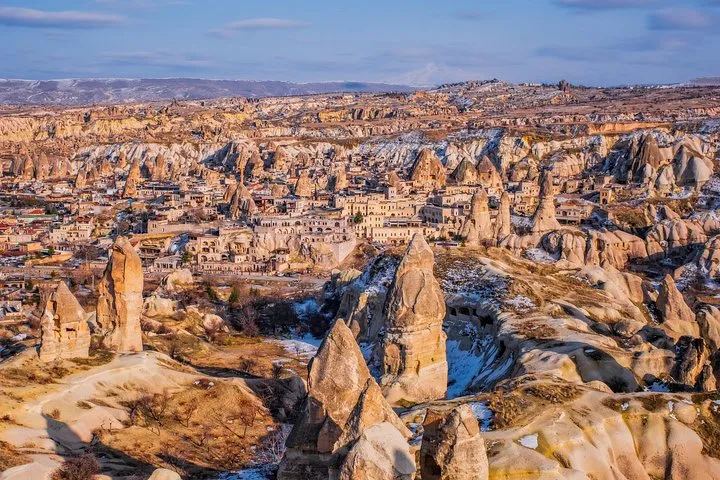 from $211.65
Full-Day Private Cappadocia Tour with Car and Licensed Guide
Your own car and licensed guide for a day, routed to your interests, with the pickup from your Göreme door. Entries and lunch are extra.
Check Availability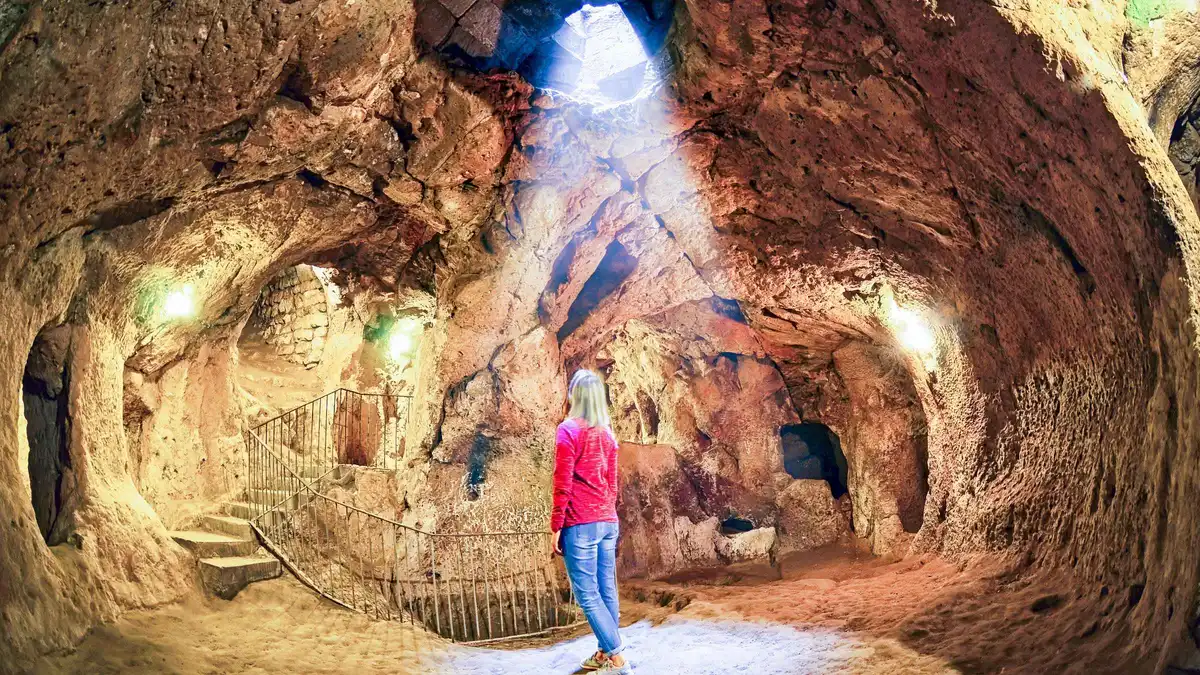 from $21.07
Full Day Cappadocia Red and Green Combined Day Tour
The whole classic loop in one day: the north valleys, the Open Air Museum side, then the underground city and Ihlara on the green half. Entry tickets are extra.
Check Availability from $1.26
Private & Shared Transfers for Kayseri and Nevşehir Airports
Meet-and-greet shuttles between your cave hotel and either airport, shared or private, priced per person from $1.26 on the shared seat.
Check AvailabilityPrices, ratings and details are the platform's own. dollar figures are the listed prices — the platform bills in your account's currency.
Mustafapaşa on the map
Village pins are approximate, distances from the Ürgüp road.
What pairs with Mustafapaşa
Ortahisar
The rock castle and the lemon storerooms, the Ortahisar guide.
12 km by road Check AvailabilityCappadocia valley walks
Gomeda is the village's own valley, the fuller route set on the valley walks page, or start again at the Göreme city guide.
Out of the village door Check AvailabilityMustafapaşa questions
Why is Mustafapaşa also called Sinasos?
Sinasos is the historic Greek name of the same place. It is the name used in older sources, in church records and by the diaspora town of Nea Sinasos in Greece, and locals use both names without confusion. This page uses Sinasos when it means the place in its merchant era.
What happened to the Greeks of Sinasos?
They left under the 1924 exchange required by the Treaty of Lausanne, resettling mostly in Nea Sinasos on the island of Euboea in Greece. Macedonian Muslim families from Kastoria moved in their place, and the village's buildings passed into their keeping. The full story is in the history section.
Is Mustafapaşa worth visiting?
Yes, once you have seen the headliners. The mansions, the carved 1729 basilica, the rock-cut churches at the village edge and the quiet lanes fill half a day comfortably, and you will share it with far fewer people than in Göreme. Come before that and the village may feel like less than its reputation, which is a question of order, not of worth.
How do I get to Mustafapaşa from Göreme?
It is about 13 km via Ürgüp. Take any Göreme to Ürgüp minibus, change at the Ürgüp terminal for the village leg, and confirm the return locally because no timetable for that leg is published. By car or taxi the whole trip takes about twenty minutes. Details on getting there.
Are the Greek churches open to visitors?
Access varies by day. The basilica of Sts Constantine and Helena opens irregularly and is sometimes used for concerts, and the edge churches depend on local arrangements. Ask at the square when you arrive rather than trusting a fixed schedule. See the walk.
Is there an entrance ticket for the village?
No ticket exists. The village is free to walk, the lanes and squares cost nothing, and individual buildings such as the basilica or the doll museum may make their own arrangements with visitors. That is part of why it suits an unhurried half day rather than a checklist hour.
Can you stay in Mustafapaşa?
Yes. Mansion hotels occupy restored houses in the old core, and the village suits a valleys-and-silence plan rather than a nightlife one. For comparisons with Göreme and Ürgüp, with hotel bands by area, see where to stay.
How long do you need in Mustafapaşa?
Two to four hours: about ninety minutes for the square, basilica and mansion lanes, half an hour more if the doll museum is open, and the rest if you add Gomeda valley. Add slack for church access, which runs on other people's schedules, and walk the lanes in morning or late-afternoon light, when the carved stonework shows its relief.
Is Mustafapaşa good for families?
Quietly, yes. There is no traffic to speak of in the core, the doll museum lands well with children, the valley walk is short enough to turn back from at any point, and nothing on this page needs a ticket or a timed entry. The honest limit is food and shops: options are thinner than Ürgüp, so plan meals around the square or eat before you come.
Cappadocia on film, for the Mustafapaşa day
Three general Cappadocia films that set the village in its region, since the quiet villages rarely get their own camera crew.
Cappadocia Turkey Travel Guide: 3 Days Itinerary in Cappadocia Vlog 4K
A three-day region itinerary, the kind of schedule a Sinasos half day slots into on day two.
Video: Alp Galip Travels15 Tips I Wish I Knew Before Visiting Cappadocia, Turkey
Practical tips that apply just as much to a village morning as to the balloon fields.
Video: Camden David24 Hours In Cappadocia | Turkey Travel Guide
A single-day frame for the region, useful for judging how much a half day here costs you.
Video: Adventures of Lauren & JasonVideos load from YouTube only when you press play.
Prices, hours and terms are set by the venue or operator and confirmed at checkout.
We may earn a commission if you book through one of our links, at no extra cost to you. Full affiliate disclosure