 Göreme City Guide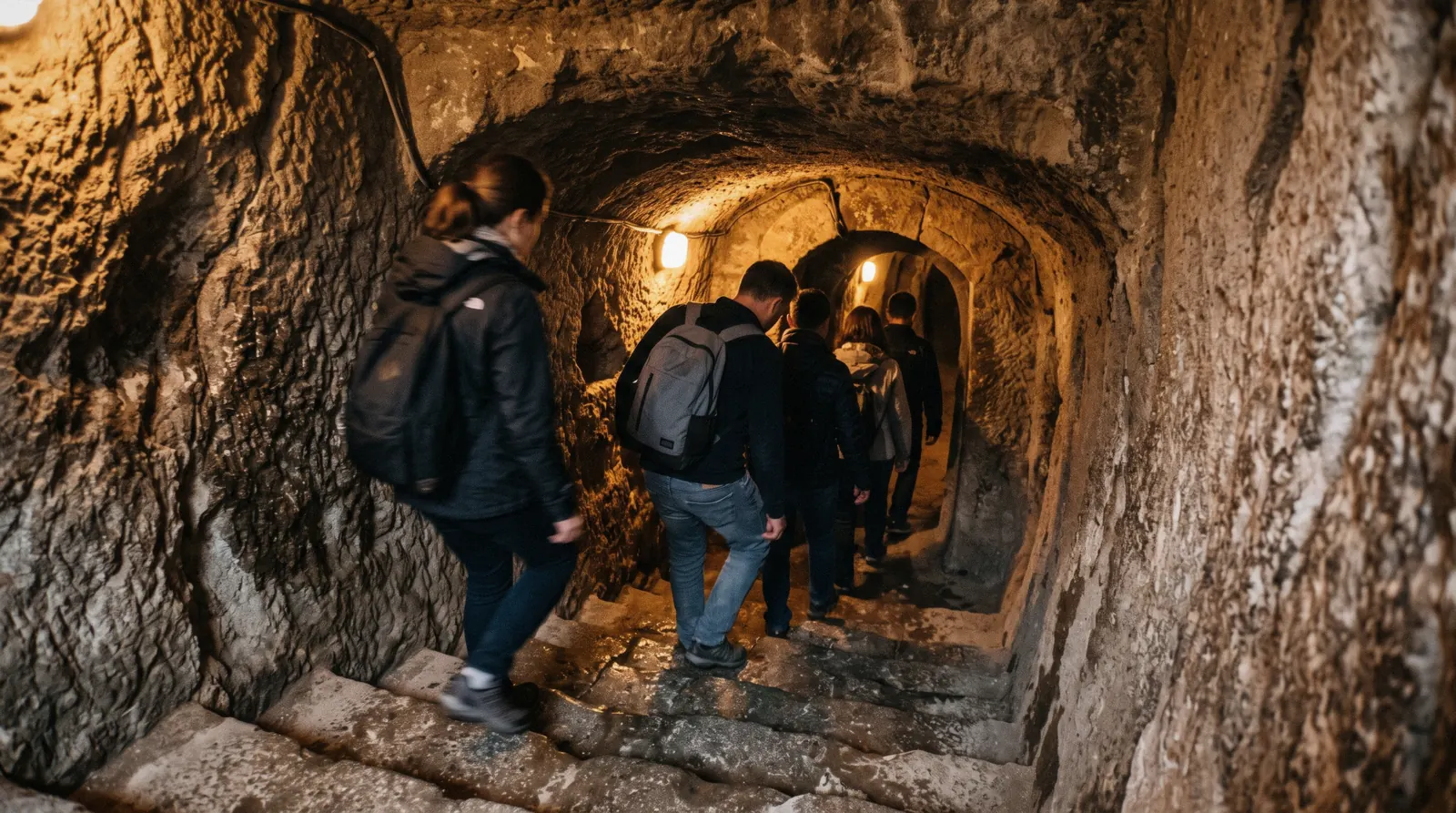
Derinkuyu Underground City
Derinkuyu underground city is the deepest of the Cappadocia refuges, more than 85 metres of tuff-bored levels under a small farming town 45 road-minutes south of Göreme. This page covers the hours, the official ticket, what the descent does to your body, and how to choose between Derinkuyu and Kaymaklı. The money questions live on the Derinkuyu tickets page, and the wider plan on the Göreme city guide homepage.
Quick answer Hours, price, depth, how long, in three lines
Derinkuyu opens 08:00–18:45 every day of the year with no closed day. An adult ticket is $14.90 (€13). The city drops more than 85 m on 18 tunnel levels, and 60–75 minutes covers everything open to visitors.
Key takeaways
- Every way in, the undated official e-ticket and the pass arithmetic are on the Derinkuyu tickets page
- The guided green tour pairs Derinkuyu with the Ihlara gorge and Selime in one day at $20, the entry ticket an optional extra at checkout
- Same gate price, different character: Kaymaklı underground city shows 4 of its 8 levels, reads wider, and opens until 20:00
Key facts
Opening hours
| Every day | 08:00–18:45 |
|---|---|
| Ticket office | 08:00–18:45 |
Closed None. On the first day of the religious holidays (Ramazan Bayramı, Kurban Bayramı) state museums open only after midday
Admission
- Adult
- $14.90 (€13)
- Reduced
- Not stated. The Ministry publishes no reduced foreign fare. Turkish citizens enter on Müzekart, a citizens-only card foreigners cannot buy
- Free
- Turkish citizens aged 18 and under and 65 and over, via QR code in the Museums of Turkey app. The free-age threshold for foreign children is not stated
Planning it
- Time needed
- Not stated by the Ministry. Our routing: 60–75 minutes underground
- Book ahead
- Optional — walk-up usually fine
- Address
- Derinkuyu, Nevşehir Province. The entrance sits inside the town, about 45 minutes by road from Göreme
Four ways in, priced from the official muze.gov.tr e-shop and the tour platforms. The official euro figure is what the museum till charges, the dollar beside it is the same money at this site's fixed rate.
Are you buying the descent alone, or the van, the guide and the rest of the valley with it?
| Option | Price | Includes | Cancel | Book |
|---|---|---|---|---|
| Official single ticketThe default. There is no timed queue to skip here, visitors flow through all day | $14.90 (€13) | One entry, undated e-ticket or gate purchase | Not stated as refundable | Official site |
| Guided green tour, 9 hAnyone without a car: the minibus does the 45-minute drive and the gorge pairing | $20 | Guide, transport, Derinkuyu, Ihlara Valley and Selime. Entry ticket an optional extra at checkout | Free cancellation per the platform | Check Availability |
| Red and green combined day tour, 7–8 hOne-day visitors who want both loops and accept the fast pace | $21.07 | Göreme Open Air Museum, the underground city, Pigeon Valley and the fairy chimneys, ticket optional | Free cancellation per the platform | Check Availability |
| Full-day private car and licensed guide, 8 hFamilies and anyone who wants the underground city before the coaches, on their own clock | $211.65 | Your routing and timings, guide and vehicle | Per the platform's terms | Check Availability |
The museum wants its €13 and nothing else: the official e-ticket is undated, so no seller can sell you a better time slot. What the platforms sell is the van, the driver and the guide, at $20 to $211.65 depending on how much of the region rides along, with entry an optional extra on the day-tour listings. All figures are the listed prices read in Q3 2026, they move with the date and the checkout price is the one you pay.
Derinkuyu entry options and day tours compared
Each card opens the operator's own page, where the calendar for your date shows what is still open. Figures are the operators' listed dollars as captured for this guide.
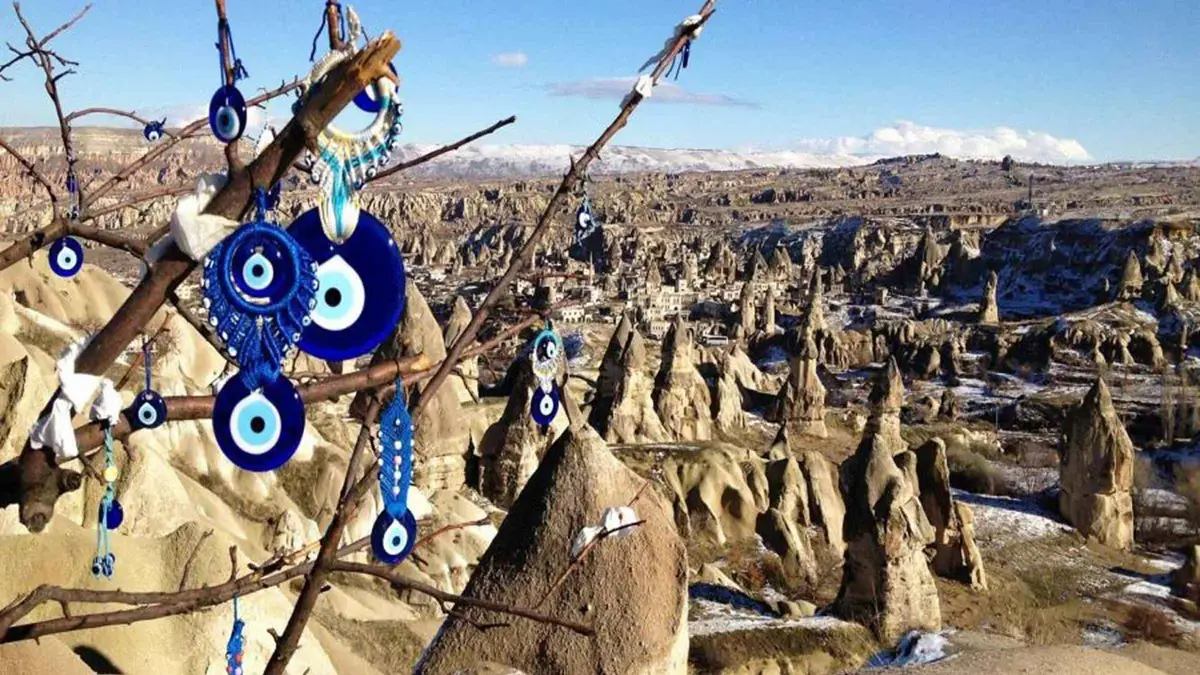 from $20
Cappadocia: Guided Green Tour with optional Lunch and Ticket
The south loop: Derinkuyu underground, the Ihlara gorge walk and the Selime rock massif, with a guide and an optional lunch.
Check Availability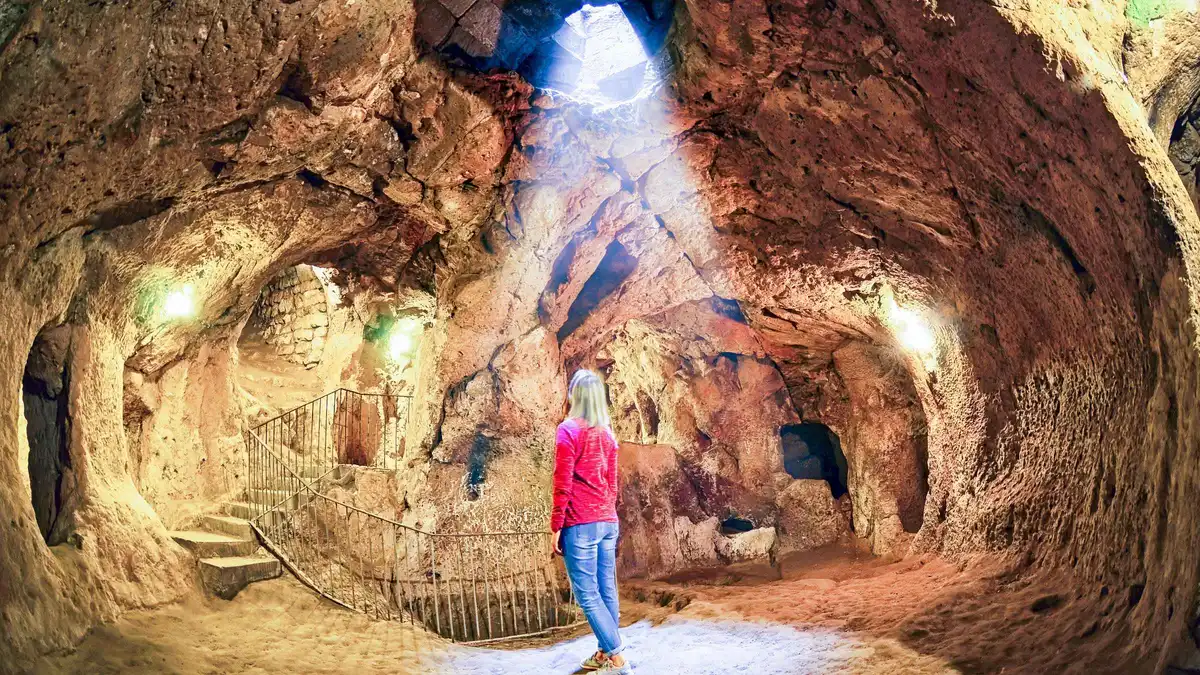 from $21.07
Full Day Cappadocia Red and Green Combined Day Tour
The whole classic loop in one day: the north valleys, the Open Air Museum side, then the underground city and Ihlara on the green half. Entry tickets are extra.
Check Availability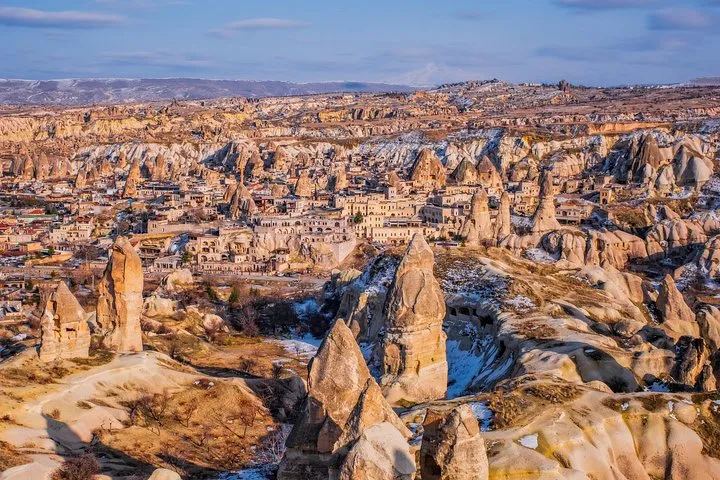 from $211.65
Full-Day Private Cappadocia Tour with Car and Licensed Guide
Your own car and licensed guide for a day, routed to your interests, with the pickup from your Göreme door. Entries and lunch are extra.
Check AvailabilityPrices, ratings and details are the platform's own. dollar figures are the listed prices — the platform bills in your account's currency.
What Derinkuyu Is, And Who Built It
Eighteen levels of tunnels cut into compacted volcanic ash, under a town whose name means deep well. The archaeology is settled about the what and contested about the who, and this page keeps the difference visible.
A refuge city, more than 85 metres down
Derinkuyu is carved into tuff, the soft stone that volcanic ash left across Cappadocia and that the whole region digs like wood. It extends to a depth of roughly 85 metres and the tunnels run through 18 levels, which makes it the largest excavated underground city in Turkey and, on the BBC's wider claim, the largest excavated anywhere. Wikipedia's history section puts its shelter capacity at as many as 20,000 people together with their livestock and food stores: stables, wine and oil presses, cellars, refectories, kitchens with the same tandoor ovens villagers still use, and chapels.
What you visit is a fraction of that. The state tourism portal's figure is that only about 10 percent of the complex is visitable, which is why an hour underground is the whole show rather than a disappointment.
The builder question has no settled answer
Ask who built Derinkuyu and the honest answer is that the dating is contested. The tunnels may have been first cut in the Phrygian period, in the 8th to 7th centuries BC, and the BBC records a competing Hittite hypothesis, with Hittite artefacts found inside, alongside the observation that Xenophon's Anabasis of about 370 BC is the oldest written work hinting at people living underground in this region. What all the sources agree on is the shape of the later story: the city was fully formed in the Byzantine era, when Christian inhabitants expanded simple cave homes into a multi-level refuge with chapels and Greek inscriptions, and it was significantly enlarged during the Arab–Byzantine wars.
Any guide who gives you a single confident date for the beginning is selling certainty the evidence does not hold.
Forgotten in 1923, found again in 1963
The refuge had a long afterlife. It sheltered Christians from Seljuk raids in the 11th century and from Timur's incursions in the 14th, and the Cambridge linguist R. M. Dawkins recorded townspeople still hiding underground as late as 1909, after the Adana massacres. In 1923 the Christian population left in the population exchange between Greece and Turkey, and the city was abandoned, its entrances forgotten.
It came back to light in 1963, when a resident renovating his house knocked through a basement wall and found a room behind it. More than 600 separate entrances have since been discovered, some of them under the basements of private houses in the town above, which is why the modern entrance sits in an ordinary street and not in a fenced archaeological park.
Derinkuyu In Its Dates
Every line carries a date only where a source dates it. The early chronology is a scholarly argument, the modern dates are documented, and the list is ordered so the argument is visible.
-
8th–7th century BC
Possible Phrygian first cuttings
The earliest the sources are willing to go: tunnels possibly first cut in the Phrygian period. Contested, and stated as a possibility rather than a finding (Wikipedia's history section).
-
c. 370 BC
Xenophon mentions underground living in the region
His Anabasis is the oldest written work that seems to reference Anatolian people living in excavated homes near Cappadocia. It does not name Derinkuyu (BBC Travel).
-
780–1180
Enlarged during the Arab–Byzantine wars
The city becomes a multi-level refuge sheltering local Christians from Umayyad and Abbasid raiders, its population approaching the 20,000 peak in this window (Wikipedia).
-
14th century
Still a refuge in Timur's era
The underground cities of Cappadocia continue to be used for protection from the Mongolian incursions of Timur (Wikipedia).
-
1909
Dawkins records a refuge flight
After the Adana massacres, a great part of the population at Axo took refuge in underground chambers and for some nights did not sleep above ground (Dawkins 1916, quoted by Wikipedia).
-
1923
The population exchange empties the city
The Christian inhabitants are expelled to Greece and the underground city is abandoned, its knowledge fading (Wikipedia).
-
1963
Rediscovered through a basement wall
A resident renovating his home breaks through and finds a room, then a tunnel network. BBC Travel tells the same year through the story of a man whose chickens kept disappearing. More than 600 entrances have since been found (Wikipedia, BBC Travel).
-
1965
Opened to visitors
The state tourism portal's Cappadocia page dates the opening to 1965 and is the only dating source this guide holds for it (goturkiye.com, via the official facts pack).
-
1985
UNESCO World Heritage inscription
The listing for Göreme National Park and the Rock Sites of Cappadocia explicitly names the subterranean cities of Kaymaklı and Derinkuyu (UNESCO, via the official facts pack).
Dates as recorded in the Wikipedia history and architecture sections (citing Dawkins 1916 and Bradt's Eastern Turkey), the BBC Travel feature of August 2022, and goturkiye.com and UNESCO's inscription record as captured in this site's official facts pack.
How Much Time To Give Derinkuyu
The Ministry states no visit length for the site, so the three routings below are ours, built on what the visitable levels hold and on how the guided groups move through them.
The variable that decides your routing is the one-way loop. Visitors go down through the levels and come up by a different staircase, and the tightest stretches are single file, so your pace is partly the pace of the line ahead of you. With about 10 percent of the complex open, the difference between a short visit and a full one is attention, not distance.
| Routing | What you get | What it skips | Door to door |
|---|---|---|---|
| The short visit | The upper levels at an unhurried pace: the stable zone, the millstone doors and the barrel-vaulted room reported as a religious school | The deeper levels and the church at the bottom of the visitable route | About 45 minutes |
| The full visit | Everything open, down to the lowest visited level and back up the exit stairs, at the pace the passages allow | Nothing open to the public, though the last twenty minutes are for people who still enjoy stooping | 60–75 minutes |
| With a tour | The guided green tour gives you about an hour inside with a guide explaining the rooms, then moves on to Ihlara and Selime | The tour's route inside is the standard one, you do not linger | About an hour underground, 9 hours door to door for the whole day |
What The Descent Is Physically Like
This is the section to read before you buy the ticket, because Derinkuyu is the most physically demanding of the region's major sites and the one where honesty saves someone a bad half hour.
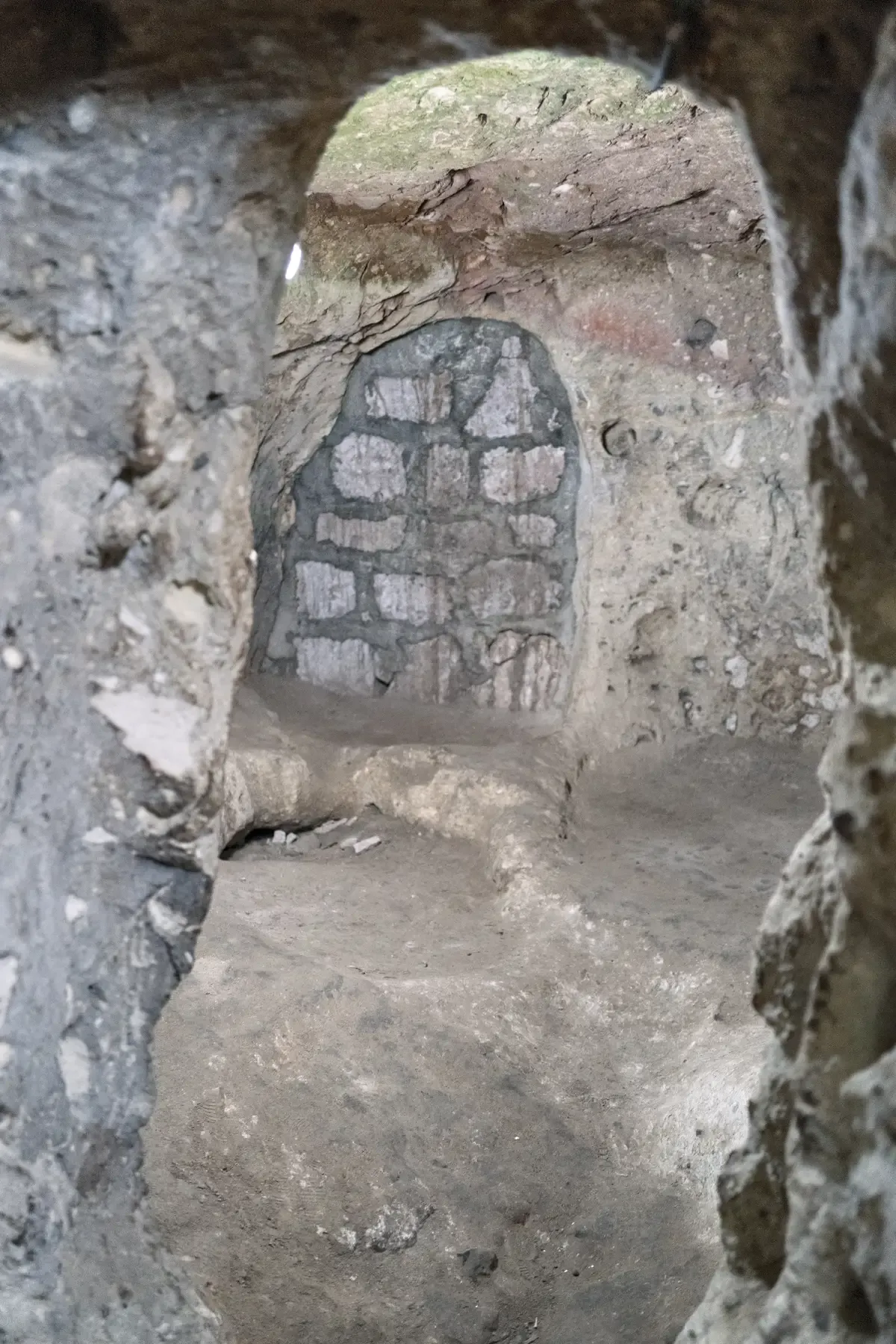
Photo: Giorgio Galeotti, CC BY-SA 4.0, via Wikimedia Commons
Low, narrow and single file
The passages are intentionally defensive, and the BBC's visitor description matches what the layout implies: hallways short enough and narrow enough that you move stooped and single file through the tightest stretches, with the walls darkened by centuries of soot. Most adults duck at the doorway lintels without thinking about it. The light is dim and even, the air still, and in the rooms between groups the silence is the thing people remember.
If you are tall, expect your back and your shoulders to do real work. If you are at all unhurried by nature, the queue ahead of you will decide your speed.
How 20,000 people breathed
The air you are breathing down there is the engineering. More than 50 ventilation shafts reach the levels below, and the widest central shafts connect many levels with the openings of no two levels ever overlapping, a layout that reads as deliberate airflow design. One shaft served as a well more than 55 metres deep, giving water to the town above and, when the surface was not safe, to the city below, where it could be cut off from below so nobody could be poisoned or lowered down it.
Stand under a shaft for a moment and you can feel the column of cool air moving.
The millstone doors
Half-ton circular stones, rolled across doorways from the inside only, sealed each level separately. The round hole in the centre of the millstone doors had a working purpose as well as a defensive one, the kind of detail guides demonstrate with a hand: sight, spear, or both, depending which source you believe. You will pass several of these doors standing half open in their slots, and they are the photograph most visitors take.
They are also original load-bearing archaeology, not reproductions, so hands off.
A straight claustrophobia test
Decide before you buy, not at the third level down. If a crowded cinema aisle, a church crypt or an airline middle seat makes your chest tighten, Derinkuyu's deepest stretches will be genuinely unpleasant: there are points where two people cannot pass and the ceiling asks you to bend. The route is a loop with staff stationed along it, and leaving partway is possible, but the honest framing is that the site is not suitable for anyone who cannot manage repeated stooping on worn, uneven steps, and it does not work for wheelchairs or pushchairs at all.
Visitors who want the underground-city experience with more generous rooms should do Kaymaklı first and keep Derinkuyu for a confident day.
Hours, Tickets And The Quiet Slots
Derinkuyu opens 08:00 to 18:45 every day, with the ticket office keeping the same hours and no weekly closed day at all. The ticket itself needs no planning: $14.90 (€13) at the gate, the same undated ticket the Ministry sells on muze.gov.tr, and the MuseumPass Cappadocia e-card, $74.51 (€65) for 3 days with one entry per site, covers this gate like every other Ministry ticket in the region. The full price picture is on the Derinkuyu tickets page.
The quiet logic is simple. The site has no timed entry, so the crowd arrives when the minibuses arrive, which from April to October is mid morning, when the green tours come down from Göreme. The first hour after opening and the last hour before close are the slots where you walk at your own pace.
- Emptiest: 08:00–09:00, and after 17:00 in season
- Busiest: 10:00 to about 13:00, when the day tours cycle through (our observation)
- Last practical entry: about an hour before close, so by 17:45 for the full route
| Session | Hours | Who it is for | Ticket |
|---|---|---|---|
| Day session | 08:00–18:45, every day | All visitors | $14.90 (€13) |
| Evening session | 19:00–21:00, office to 20:15 | Aimed at Turkish citizens | $4.10 (₺200) |
| Religious-holiday first day | Opens after midday only | All visitors | Standard ticket |
How To Get To Derinkuyu From Göreme
By car or by tour, 45 road-minutes
Derinkuyu sits about 45 minutes south of Göreme down the plateau road, an easy drive that most visitors never make because the tours make it for them. The guided green tour is the classic pairing, Derinkuyu in the morning then the Ihlara gorge and Selime, at $20 for the seat. The red and green combined day tour folds the underground city into both loops if you have a single day.
And the full-day private car with a licensed guide is the version where you arrive at opening with the site to yourselves, which is worth $211.65 to some families and a wild overpay for everyone else. The routing options are gathered on the day trips from Göreme page.
By dolmuş, with a change in Nevşehir
There is no direct minibus from Göreme. The route runs Göreme to Nevşehir's otogar, then a second minibus from the otogar toward Derinkuyu, and it works, slowly. Here is the finding worth printing: no official fare table or timetable for these rural minibuses is published online at all, the operator's own pages cover the Göreme–Avanos–Ürgüp corridor only, so you confirm times at the otogar on the day.
Carry lira cash, small notes, and do not attempt the dolmuş version if you have a fixed afternoon plan. The practicalities of minibuses across the region are on getting around Cappadocia.
Derinkuyu Or Kaymaklı: The Short Version
Both cities cost the same official $14.90 (€13), so this is a routing and temperament decision, not a money one. The figures below come from the official fee list and the sources named in each cell.
| Depth and size, as sourced | Hours | Listed price | Pick it if | |
|---|---|---|---|---|
| Derinkuyu | 18 tunnel levels, more than 85 m deep, the deepest and largest excavated of the underground cities | 08:00–18:45 | $14.90 (€13) | You want the full descent and can handle tight, stooping passages |
| Kaymaklı | 8 levels with 4 visitable, rooms organised around ventilation shafts so the chambers read wider (HistoryHit calls it the widest) | 08:00–20:00 | $14.90 (€13) | You want the evening hours, generous rooms, or a shorter drive from Nevşehir |
The full split, including what a green tour pairs with which city, is on the Kaymaklı underground city page, and doing both in one day is a plan, not a compromise.
At Derinkuyu: What To Do, And What Not To
Every line here is a decision argued somewhere above, compressed into the form you can act on that morning.
Do
- Aim for the 08:00 opening and have the descent to yourselves before the coach waves land
- Wear shoes with grip and clothes you can stoop in, the steps are worn stone and the lintels are low
- Leave the big bag at the hotel, the passages have no room for a daypack never mind a suitcase
- Carry small lira notes for the ticket check and for the Nevşehir dolmuş change
- Do the claustrophobia self-check at the entrance, where walking back out is easy and dignified
Don't
- Do not attempt the deepest levels with severe claustrophobia, the site will still be there on a braver day
- Do not bring wheeled luggage or wide backpacks into the tunnels, there is no cloakroom worth planning around
- Do not touch or lean on the millstone doors, they are original load-bearing archaeology
- Do not plan the dolmuş return without daylight to spare, timetables are unpublished and seasonal
- Do not expect the site's sparse labels to explain the rooms, arrive with the history above or take the guided green tour
Five Things Most Visitors Do Not Know About Derinkuyu
All five come from the sources this page cites, and each one changes something practical about the visit.
- Derinkuyu and Kaymaklı were connected. Wikipedia's history section carries the 8–9 km of tunnels linking the two cities, a corridor you cannot walk today but which explains why the two sites feel like one system when you visit both [Wikipedia, History section]. - The air was engineered, not hoped for. More than 50 ventilation shafts reach the lower levels, and the 55-metre well could be sealed from below during a siege, so the city could not be starved of air or water from the surface [BBC Travel]. - The stables were at the top for two reasons. Keeping livestock nearest the surface took the smell and the gases away from the living levels and used the animals' body heat as warm insulation for the cold months [BBC Travel]. - There was a school down there. The spacious barrel-vaulted room on the second floor is reported as a religious school, with the rooms to its left used for study, which tells you the refugees planned on staying months, not hours [Wikipedia, Architecture section]. - The name is the hydrology. Derinkuyu means deep well, after the shafts that watered the settlement and the town above it, and the town's Cappadocian Greek name was Malakopi, plausibly from the Greek for soft, after the tuff everyone kept digging [Wikipedia, Etymology section].
Derinkuyu Underground City Map: The Entrance And The Pairing Stops
The ticketed entrance in the town, with the two stops a day here is usually paired with, south to the Ihlara gorge or north to Kaymaklı.
Next Stop From Derinkuyu
Drive times are our estimates from the GPS distances, and the roads here are good two-laners all the way.
Kaymaklı Underground City
The natural second city, and the easiest comparison you will make all trip: same $14.90 (€13) gate price, 4 of 8 levels open, rooms organised around the ventilation shafts so it reads far wider, and hours to 20:00 when Derinkuyu is shutting. Kaymaklı underground city has the full comparison.
about 10 min by road Check AvailabilityIhlara Valley
The green-tour pairing: a river gorge with rock churches along a walkable 4 km section from the Ihlara village gate. The örenyeri ticket is $17.19 (€15) and includes the Selime entrance. Ihlara Valley covers the gates and the hike.
about 50 min by road Check AvailabilitySelime Monastery
The cathedral-sized rock monastery that ends the valley, and the reason the green tour runs this direction. It has no standalone ticket: entry is the Selime entrance of the same Ihlara ticket, which the Ihlara Valley page prints in full.
far end of the gorge Check AvailabilityDerinkuyu Underground City Questions
Why was Derinkuyu abandoned?
In 1923. The Christian population of the region left in the population exchange between Greece and Turkey, the city's remaining users were gone, and knowledge of the entrances faded until a home renovation broke through to a tunnel in 1963. The refuge had been used as late as 1909, when Dawkins recorded townspeople hiding underground after the Adana massacres.
How did people breathe in Derinkuyu?
Through more than 50 ventilation shafts, with the widest central shafts connecting many levels so that no two levels' openings overlap, an airflow design rather than an accident. One shaft doubled as a well more than 55 metres deep that could be cut off from below. You can feel the draft under the shafts today.
Who built the Derinkuyu underground city?
The dating is contested, and any single answer is wrong. The first tunnels may have been cut in the Phrygian period in the 8th to 7th centuries BC, a Hittite hypothesis exists with Hittite artefacts found inside, and the city as you visit it was fully formed in the Byzantine era and enlarged during the Arab–Byzantine wars of 780–1180.
How deep is Derinkuyu, and how much of it can I see?
More than 85 metres down, on 18 tunnel levels, the deepest and largest excavated underground city in Turkey. Only about 10 percent is visitable, and a full circuit of what is open takes 60 to 75 minutes at passage pace. The hours and the $14.90 (€13) ticket are on the Derinkuyu tickets page.
Is Derinkuyu too claustrophobic to visit?
For some people, honestly, yes. The tightest stretches are single file with low ceilings and repeated stooping. If narrow crowded spaces are hard for you, Kaymaklı is the calmer visit, its rooms organised around shafts and read wider, and you lose little. A guided day such as the green tour also keeps the underground stop to a fixed hour with a guide who reads the group well.
Can children visit Derinkuyu?
No official age limit is published, and the free-admission threshold for foreign children is not stated by the Ministry. The judgment call is physical rather than bureaucratic: can your child manage repeated stooping, dim light and holding formation in single file? Families who hesitate usually do better at Kaymaklı, and the Göreme with kids page collects the rest of the region's child-friendly calls.
How long do you need at Derinkuyu?
The Ministry states no duration. Our routing: 45 minutes for the upper levels in a rush, 60 to 75 minutes for the full loop, about an hour with a tour group moving at guide pace. Add the 45-minute drive each way from Göreme when you plan the day, and note the last practical entry is about an hour before the 18:45 close.
Where Derinkuyu Fits In A Cappadocia Day
Two shapes work. The tour day: the guided green tour takes Derinkuyu in the morning, then drops into the Ihlara gorge and finishes at Selime, back in Göreme for the evening, which is why it is the region's standard first full day. The do-it-yourself day: a rental car at the 08:00 opening, Derinkuyu before the coaches, lunch in the town, then Kaymaklı on the way back north and still home before the light goes, since Kaymaklı keeps its ticket window open to 19:15.
If you are counting days rather than hours, the three-day Göreme itinerary places both underground cities, the things to do in Göreme list ranks everything else, and the Göreme map shows the whole circuit. The Göreme city guide homepage holds the rest.
Derinkuyu On Film: The Descent, Filmed
Three films that show what photographs cannot, which is how narrow the passages run and how the levels connect as you drop.
Inside the Underground City once Housed 20,000 People: Derinkuyu
A full walk through the levels, close to what you will actually see underground.
Video: Discover With Ruhi CenetAncient Underground City Discovered in Turkey | Cities of the Underworld (Season 1) | History
The history and the defensive engineering, useful background before you pick between the two cities.
Video: HISTORYDerinkuyu Underground City Turkey Tour Documentary
A calm tour documentary whose footage shows the passage widths better than stills do.
Video: Wonderliv TravelVideos load from YouTube only when you press play.
Prices, hours and terms are set by the venue or operator and confirmed at checkout.
We may earn a commission if you book through one of our links, at no extra cost to you. Full affiliate disclosure